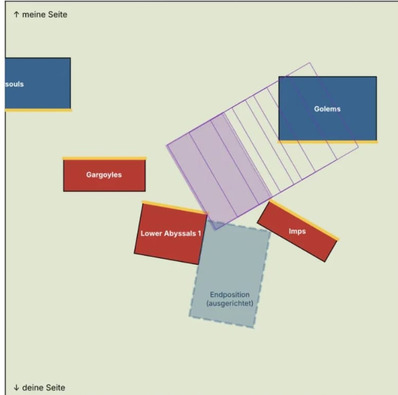
Is this charge possible? It feels wrong that the unit can Position on the other side. But i cannot find a rule that definitely says this is not possible.
1 Like
The unit is not touching the initial point of contact after aligning flush, is that not still a requirement?
1 Like
There are no longer specifically distinct steps set out in the rules for the various stages of a charge, but you do still need to be be legal throughout.
This charge is only viable if the charging unit is a flyer, as otherwise you cannot meet this part.
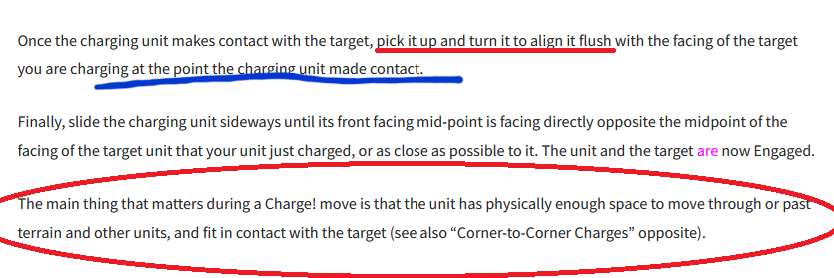
“Once the charging unit makes contact with the target, pick it up and turn it to align it flush with the facing of the target you are charging at the point the charging unit made contact.”
1 Like
The main thing that matters during a Charge! move is that the unit has physically enough space to:
-
Move through or around terrain and other units.
-
Make contact with the target and fit into position (see also “Corner-to-Corner Charges”).
Both conditions are met here.
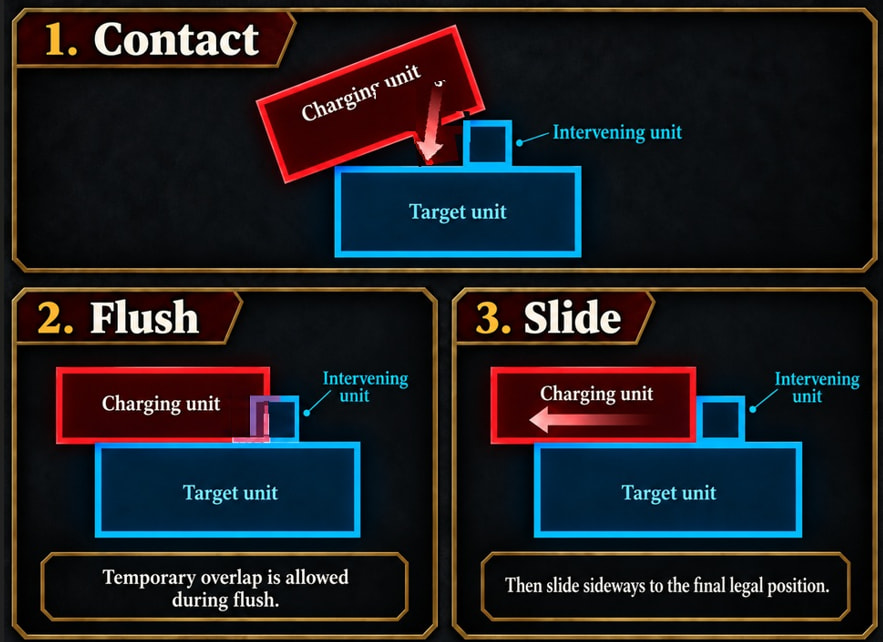
If this charge were not allowed under RAW, then the clearly legal charge shown in my images wouldn’t be allowed either.
However, I don’t think this interaction is intended under RAI.
For my example:
Once the charging unit makes contact with the target (1) , pick it up and turn (2)it to align it flush with the facing of the target you are charging at the point the charging unit made contact.
Finally, slide (3) the charging unit sideways until its front facing mid-point is facing directly opposite the midpoint of the facing of the target unit that your unit just charged, or as close as possible to it. The unit and the target are now Engaged.
1 Like
Your example is absolutely fine and is covered in the Complex Cases bit at the end of the book.
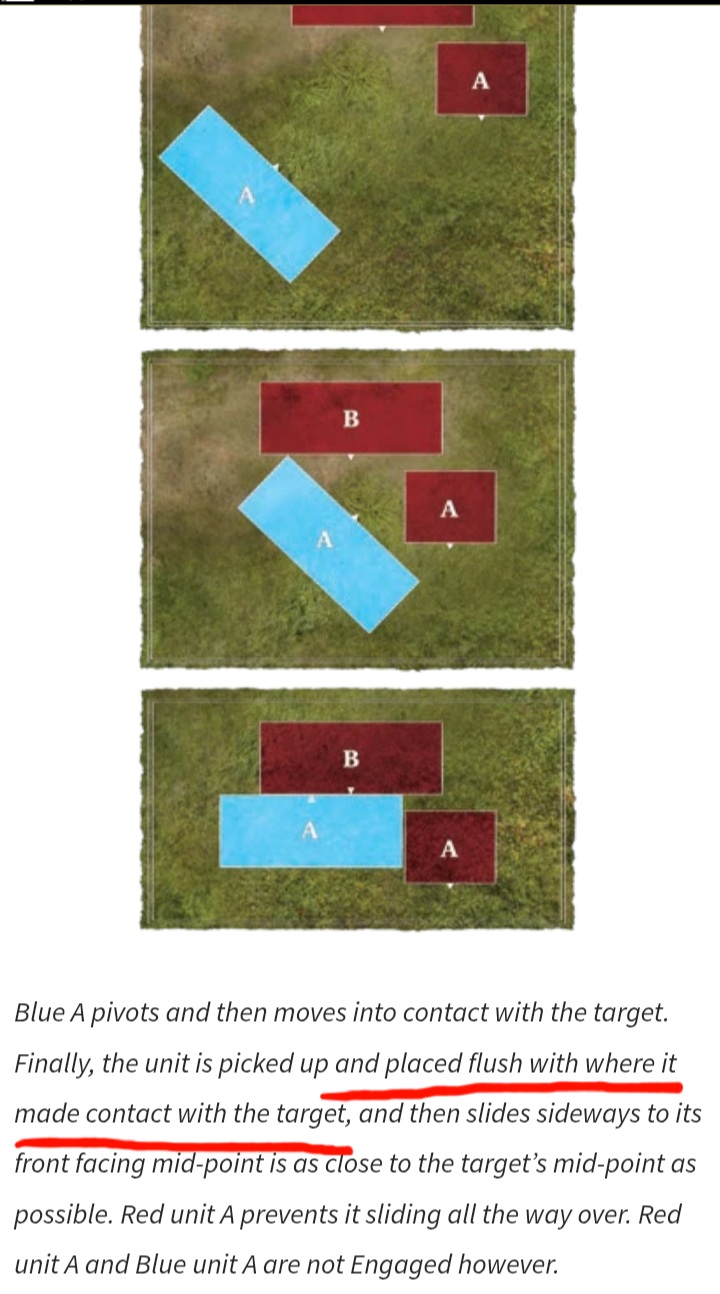
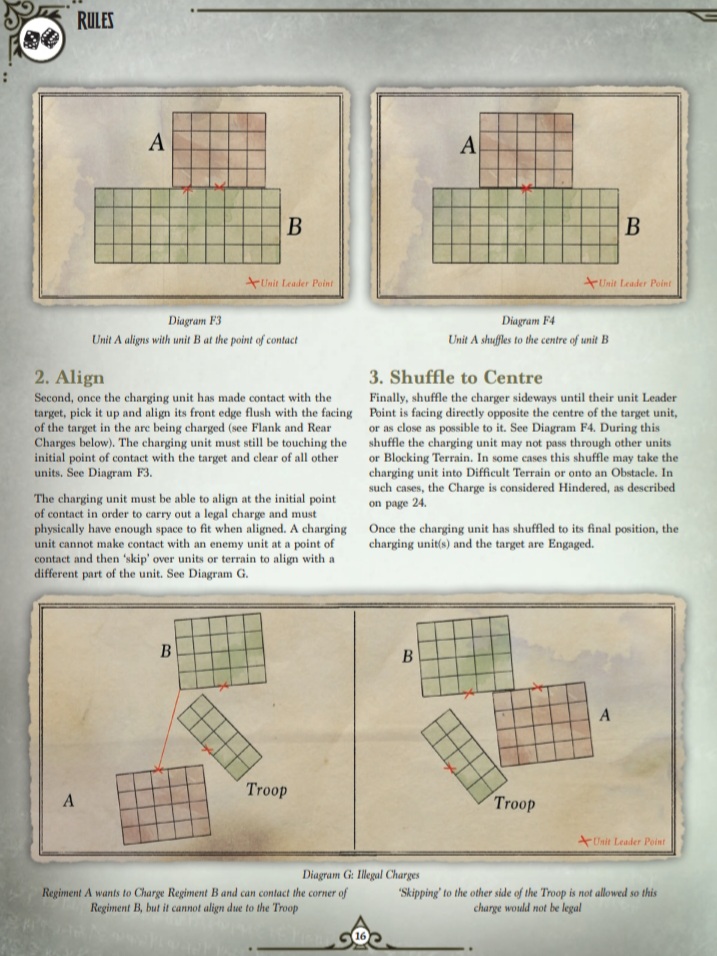
The problem with the situation in the OP is that the charging unit cannot do the underlined without being over an enemy unit.
While 3rd explicitly prohibited the ‘skip’ over a unit, the rules still prevent it.
“The charging unit must be able to align at the initial point
of contact in order to carry out a legal charge and must
physically have enough space to fit when aligned. A charging
unit cannot make contact with an enemy unit at a point of
contact and then ‘skip’ over units or terrain to align with a
different part of the unit.”
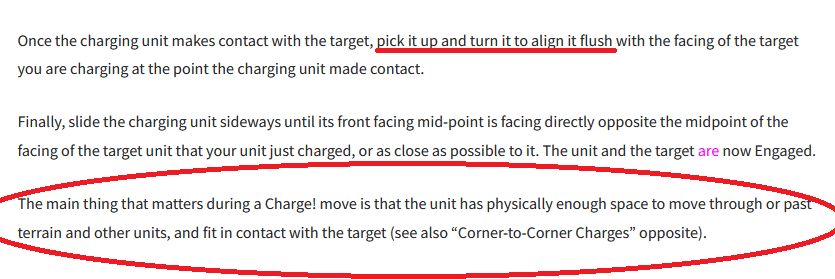

As a TO, I would not allow this charge, unless your unit flies.
I’m not 100% sure about RAW, but its definately not RAI.
You assume that a unit cannot flush on top of another unit. However, this directly contradicts the example given in the rulebook.
You’re also ignoring the key summary of the charging rules:
"The main thing that matters during a Charge! move is that the unit has physically enough space to:
Move through or around terrain and other units.
Make contact with the target and fit into position (see also ‘Corner-to-Corner Charges’)."
This leaves us with two possibilities:
-
Flushing must include sliding, which is not supported by the rules.
-
A unit may temporarily overlap another unit during the flush, meaning it must also be allowed to slide through that unit afterwards.
You can’t have it both ways.
RAW, this seems pretty clear to me.
RAI, I don’t believe this interaction is intended, but unfortunately, it isn’t addressed in the FAQ either.
You are wrong, @TieKey
The unit needs to end flush (still connected to the point of contact) before moving on to sliding towards the center.
The exceptions to this are Flyers and if you are moving through a Yielding Hero, in which case you are allowed to align while holding your unit in the air (in practical terms you are allowed to skip the align step) and go straight to placing the unit in its final position.
I believe there used to be an FAQ entry in 3rd ed that is no longer there that perhaps enforced this (something about “teleporting through units”?) - maybe that should be added back to make it even more clear?
1 Like
like I said, this is true if you are a Flyer or currently going through a Yielding Hero. For everybody else, not being able to align the unit flat will make it an impossible charge.
Let’s take this step by step and see where exactly we start to disagree.
0) References to 3rd Edition rules or FAQs have no relevance when discussing RAW in 4th Edition. We already agree on RAI anyway.
1) You must make contact with the target unit at some point along the correct facing.
2) The rules then tell us that two things happen: you pick up and turn your unit (3), and afterwards slide it (4) into a legal position, aiming to get the centre points of both units as close together as possible.
3) You pick up your unit and turn it so that it is aligned flush with the target.
3.5) According to the example in Complex Cases and Clarifications (“Aligning flush with the target – but not enough space”, p. 75), obstacles and other units are ignored during this step.
4) Your unit is then slid sideways until it reaches a legal position.
5) There is an official summary of the Charge rules, which establishes two requirements:
5.1) You must be able to reach the target.
5.2) There must be enough free space alongside the target for your unit to end up in a legal position.
So, which of the points above do you believe I have misinterpreted, and why would that make the charge shown by the original poster illegal under RAW?
How would you suggest it needed to say in the rules for it to be the way Sceleris and I claim it is? What’s missing from our presentation?
I claim that you ignore the part about placing the unit flush at the point of contact. The units not mattering part is because you dont turn or pivot to place the unit flush, in fact you just pick up and place it. (the rules may have used the word pivot there in one of the images I believe, which is not helpful). It still doesnt repeat the part about units not mattering when it goes on to describe the sliding towards the center.
If we work quick now we can maybe influence the upcoming FAQ in the Arrogance book. 
1 Like
Psst, maybe that’s why I’m being so strict about this. 
How would you suggest it needed to say in the rules for it to be the way Sceleris and I claim it is? What’s missing from our presentation?
Something like in the 3rd Edition FAQ?
I claim that you ignore the part about placing the unit flush at the point of contact. The units not mattering part is because you dont turn or pivot to place the unit flush, in fact you just pick up and place it. (the rules may have used the word pivot there in one of the images I believe, which is not helpful)
So your point is that “pick it up and turn it to align it flush with the facing of the target you are charging at the point the charging unit made contact” actually means “pick it up, turn & slide it to align it flush with the facing of the target at the original point of contact, without overlapping any other units or obstacles”?
And that the rule summary:
"The main thing that matters during a Charge! move is that the unit has physically enough space to:
-
Move through or around terrain and other units.
-
Make contact with the target and fit into position (see also ‘Corner-to-Corner Charges’)."
Actually means that condition 2 also requires the unit to fit into the contact position without overlapping any other units or obstacles (apart from possible exceptions for Yielding units)?
Is that a fair summary of your interpretation?
Yes, I would say.
Perhaps with a small caveat about this part:
“pick it up, turn & slide it to align it flush" as I would claim it has no actual physical movements limited by turns or slides but actually the more liberal “pick it up and place it back down in the correct position”.
I agree the rules describes it as a pivot but I think that is more to describe when goes on that limiting it.
The Align and the Slide are two separate actions and you need to be able to do the first legally before doing the second and shouldn’t be rolled into one.
Adding the first sentence of the second para in the screenshot above “The charging unit must be able to align …” would seem to make everything clear?
I think the connection between “the point of contact” and “align” has to be clean (again).
You mean, needs to be made more obvious?
Exactly. To be still in touch with the initial point of contact when flushing is of critical importance for the understanding of the rule.