Actually I just noticed no unit type has a defined troop and horde size to them. Regiments are given specific sizes and then the rules just say to halve it for troops and double it for hordes.
I think this is certainly harder to follow then the single table we had back in 3rd edition. That would be so much clearer.
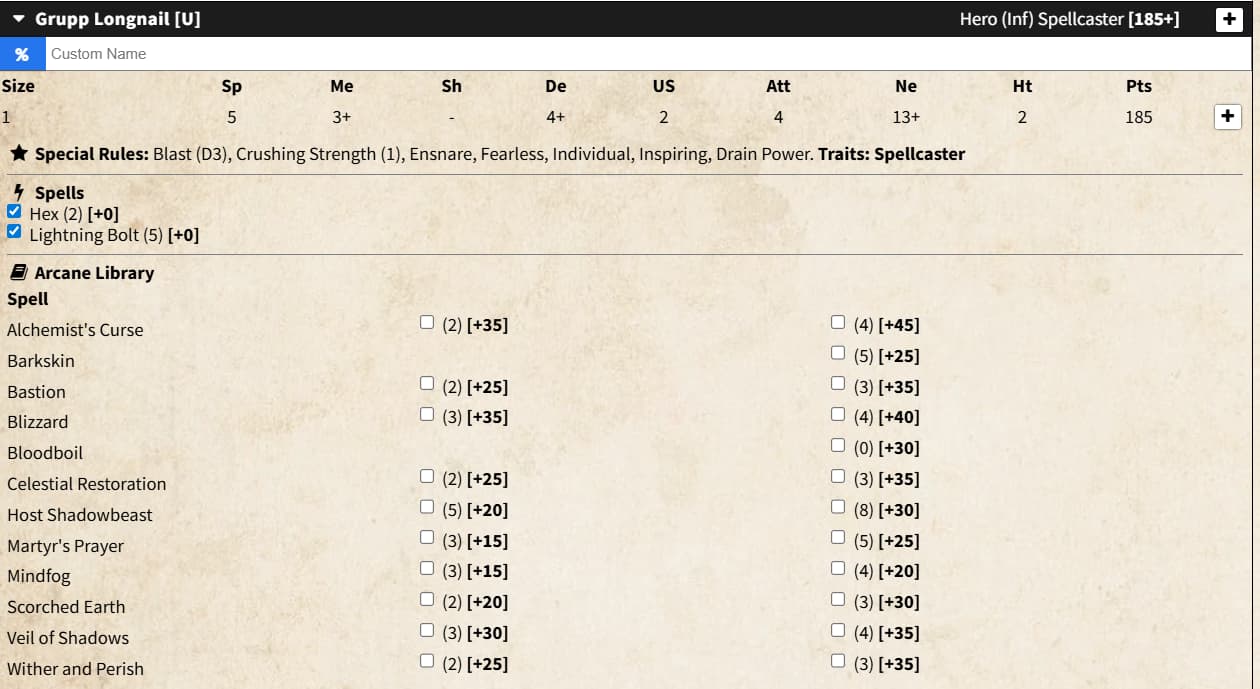
Hi someone in my community asked if Grupp gets his Blast (D3) on his spells? This Blast (D3) exists in his special rules from 3rd Edition when he had no spells despite being classified as a Spellcaster. Now, he gets loved and got 2 spells and have access to the Arcane Library. Due to the current wording and rules, it appears he gets to use his Blast (D3) for his spells too.
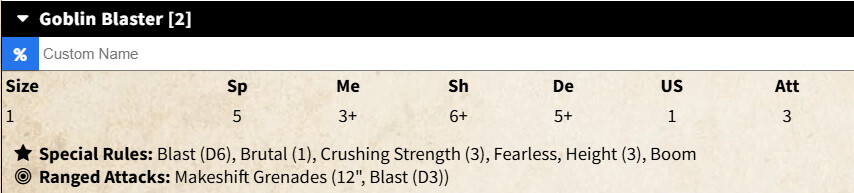
In another example, the Goblin Blaster have Blast(D6) in its special rules section, and the ranged attack profile has Blast(D3). however looking back, there’s not Blast(D6 - Combat) so the rules seem blurry since Blast(D6) is in its special rules section it should apply to its ranged attacks too, and the only reason we don’t do so, is because the Blast (D3) in the ranged profile makes it more obvious that the intent is D3 only, if not it will be strange to have Blast(D6) and Blast(D3) in the same attack.
Highlighting the above special rules, i would like to give an example that if Grupp or Goblin Blaster had Vicious in its special rules section, it would have affected both melee and ranged attacks. So based on wording of Blast Special rules, it would have affected both melee and ranged.
My suggestion if the intention was for blast to be for Combat, to have it written as Blast(D# - Combat) for both Grupp and Goblin Blaster, and any other profiles with blast in its base special rules section. The only blast that is clearly for a specific attack profile is when its only written in the unit’s ranged attacks special rules profile.
So in summary, 1st question is whether BlastD3 on Grupp applies to his spells, and 2nd is a suggestion to have Blast(D# - Combat) to clarify this position for Grupp, Goblin Blaster, and any other profiles which has Blast in its base special rules profile and spells/ranged attacks.
This is a summary of a discussion from the French KoW Discord channel.
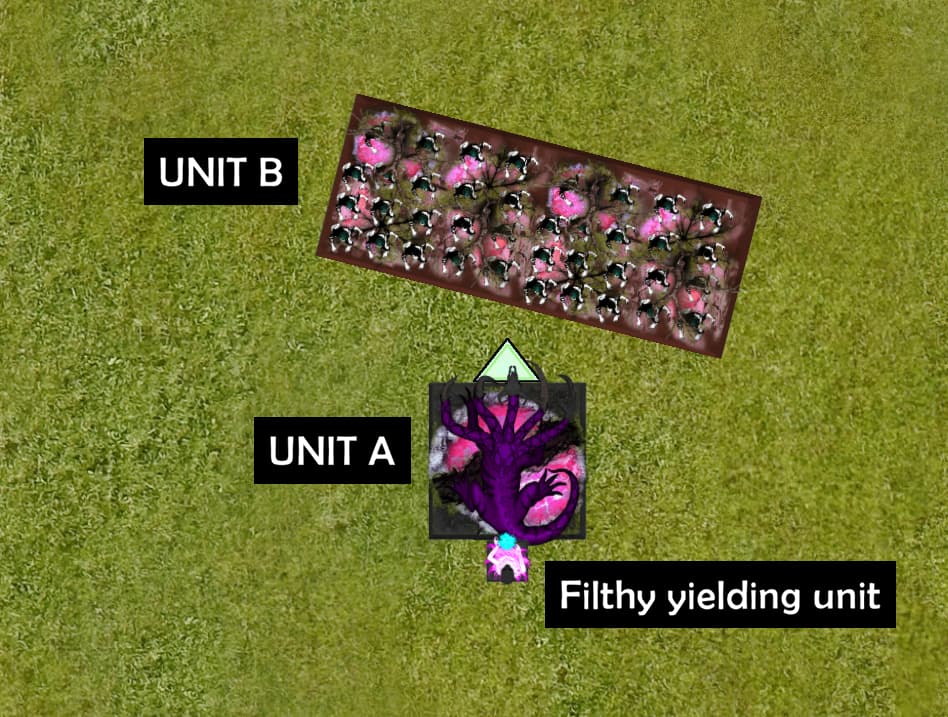
In the case where Unit A is charged in the rear or flank by a yielding unit, if Unit A is given a Halt! order and destroys the yielding unit, it may then make a Forward! move of 1d6" and potentially charge another unit (Unit B).
This interaction feels somewhat counterintuitive. We were wondering whether this is simply a very rare edge case resulting from the (very welcome) simplification of the Overrun rule. It may be that the original intention was for the Forward! move allowing a charge after destroying a yielding unit to apply only when the unit is facing the yielding unit it destroys?
LOS and cover clarification. This specific scenario isn’t covered by any of the examples in the rules.
Unit A is behind a forest from Unit B. The forest is large enough to completely block LOS to both units.
Unit A moves up so it’s front facing is within the forest but it’s center-point is not.
Is the following correct:
Both units can now see each other, as Unit A’s front face is in the terrain and Unit B can see any part of unit A in the terrain.
If unit A now shoots at unit B, unit B will get cover as the terrain is intervening the line to unit B.
If unit A moved forward so it’s centre point was now in the forest then unit B would not get cover.
In either position, if unit B shot unit A then unit A would get cover.
If instead of a forest there was a hill, unit A touching with it’s front but not centre-point would also provide LOS and cover to both units for shooting, but if unit A moves it’s centre-point onto the hill neither unit would then get cover.
Normally, spells always hit on 4+ and ignore all the normal to-hit modifiers for Ranged attacks, including any modifiers from special rules or cover.
There are however a few spells that are marked as Magical Missile, which make exception to the above, as they also hit on 4+, but all to-hit modifiers apply
“Modifiers” from pg5 are things that change the value of the dice rolls up or down.
Spellward special rule is a -1 to hit with spells on the unit, but there’s no exception given for it to work on non-Magic Missile spells. This seems like an error, and that the Spellward or spell rules should state it works on all spells.
Hi just checking if there will be answers/rulings to the unanswered questions soon. These interactions pop up in every game and being able to play the game properly will be nice.
If there two units position with one behind the other, their front centre points directly in a line to an enemy’s front centre point, what position do those units take if they perform a multi charge against that enemy unit?
The rules says that multi charging units can not cross over sides, but in this case all units are in the centre and unlike 3rd edition there’s no rule saying it’s the charger’s choice. Is it still the charger’s choice or do you need to randomise?
I also think a clarification is needed on: when choosing to ignore a Yielding unit, does that last for one action, for the whole phase, or for the rest of the turn?
if it’s only for one action, an engaged unit can both shoot out “through” the Hero AND fight the Hero in the combat phase.
A follow-up is: can a unit ignore it only to temporarily dispose of its own status as engaged, or can it ignore it to remove another units status as engaged?
The difference is shooting out while engaged with an enemy yielding hero vs shooting into an enemy unit that is engaged with a friendly yielding hero.
Is the intent of Host Shadowbeast for any unit that can take arcane library spells to be able to case Host Shadowbeast on themselves regardless of unit type?
If you roll We Are Doomed! (double 6s) for a nerve test and result doesn’t exceed the units nerve, do they get to force the dice to reroll if they are near a source of inspiring/very inspiring?
Wording seems to indicate they passed the nerve check. Inspiring wording might mean they could still reroll if they would be wavered (as they suffered a wavered result from a nerve check), but not if they were to suffer d6 damage.
If you withdraw and touch an enemy Yielding Hero… can you choose to ignore it and if you go completely through, you are safe? what if your move is not long enough to end clear - then you are forced to “not ignore it” and get Routed?
When withdrawing through a friendly unit, is your unit always Wavered?
Or is it only wavered if your move was not long enough, and you had to push your unit an extra distance?